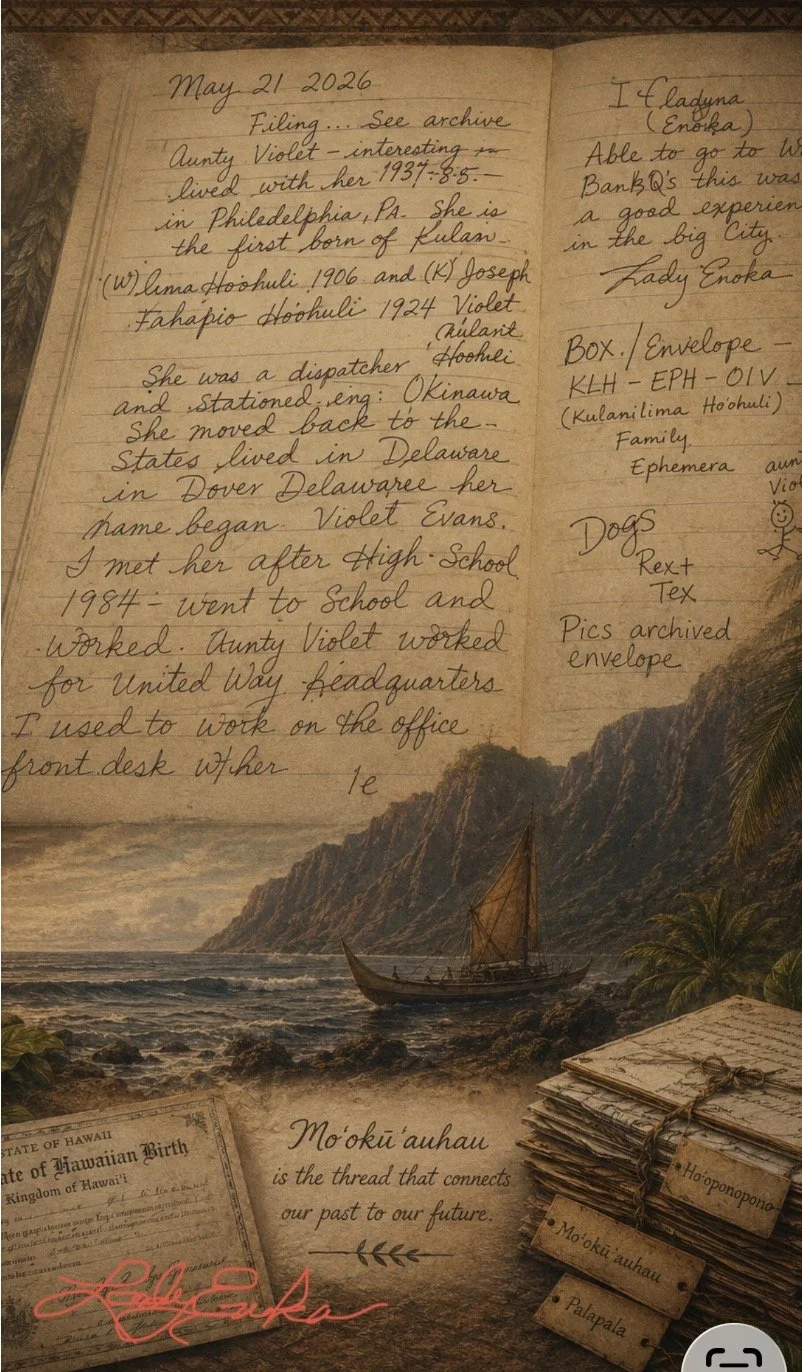
Table talk
What are Archives?
The archives exist to preserve the records entrusted to each generation before they are lost to time.
Stewardship is more than protecting documents; it is the responsibility to safeguard genealogy, history, culture, and the voices that shaped them.
Every record, painting, chant, and written account becomes part of a living archive for those who follow.
An archive does not rewrite history—it preserves it with care, integrity, and respect.
Through faithful stewardship, future generations are given the opportunity to understand both their inheritance and the responsibilities that accompany it.
The work of a keeper of records is measured by Stewardship and commitment to ensure that memory knowledge and truth endure.
Census Records
Table Talk
Where to start…? Go au au, yes good idea before we start take a dive down the beach… then we can think…
U.S Federal Census
Kingdom of Hawaii Census (before U.S. territorial government)
1866
1878
1890
1896
These are the last censuses of the Hawaiian Kingdom/Republic era that survive in whole or in part. Many earlier records no longer exist…
source: ags.hawaii.gov
U.S. Territorial and State Census
1900 First U.S Census of Hawaii Territory
Every 10 years …1950 (latest census open to the public under the 72 year rule
Source Department of Accounting and General Services Census Records.
Census.gov
Census records create a timeline of a family through history. They document who was living in a household, approximate ages, relationships, occupations, birthplaces and where a family lived at a specific point in time. When combined with birth, marriage, death, land, probate, military and church records, the census helps confirm identity across generations and reveals changes that occured over decades. It is often the first document researchers use to connect one generation to the next.
Private vs Public Records…
Table Talk
if records are the foundation of family history. Why do some families have complete archives while others are searching for fragments.
What happens when records are never preserved, never passed down or become separated from the families they belong to?
Who becomes responsible when a family’s records are scattered, forgotten, or no longer accessible?
Every family has a history. Some inherit letters, photographs, deeds, journals, genealogy, and unanswered questions. What shapes the difference, and what responsibility does each generation have to preserve what remains?
I have a Public file?
Yes, you have a public file? How? I never do nothing.
It’s information that you filed through the courts. No wait a minute that’s confidential yes it’s public confidential information. I’m not following.
What everybody know our business ? Of course, the scholars , the politicians, the activist, the next door neighbor, and our pet pig maimai.
Private files are records of the genealogy, (side note, third parties are producing genealogies that’s why I wasn’t found).
Chants, grief scrolls, maps and burial grounds stories your Kupuna told of the days long ago… but in their mind still young, still Hana ( work) the land. The taro in Hawaiian families signify life, restoration and healing.
Great your starting!
One question.
one page.
One file.
Lady Enoka
Keeper of Records
Table talk
Before answering the question, Understand the Question!
Imagine we have two records that disagree?
What would you do if your family story was recorded differently from what your elders taught?
What am I going to do about it?
Who’s involved family genealogist (side note Hawaiian families has a mo’oku’auhau cherish them mine is with our ancestors. I am the keeper of the mo’ku’auhau. KEEPER OF RECORDS).
Table Talk
Customary Rights…now what?
Native Hawaiian customary rights are protected. You found references to Hawaii’s constitution, common law, kuleana stewardship, and genealogy. So naturally, lets apply when ancestral land is involved in a partition or forced -sale case.
Wow, umm this is deep. but , my question is understanding the right is recognized by who? what are you talking about? by who? The judge!